
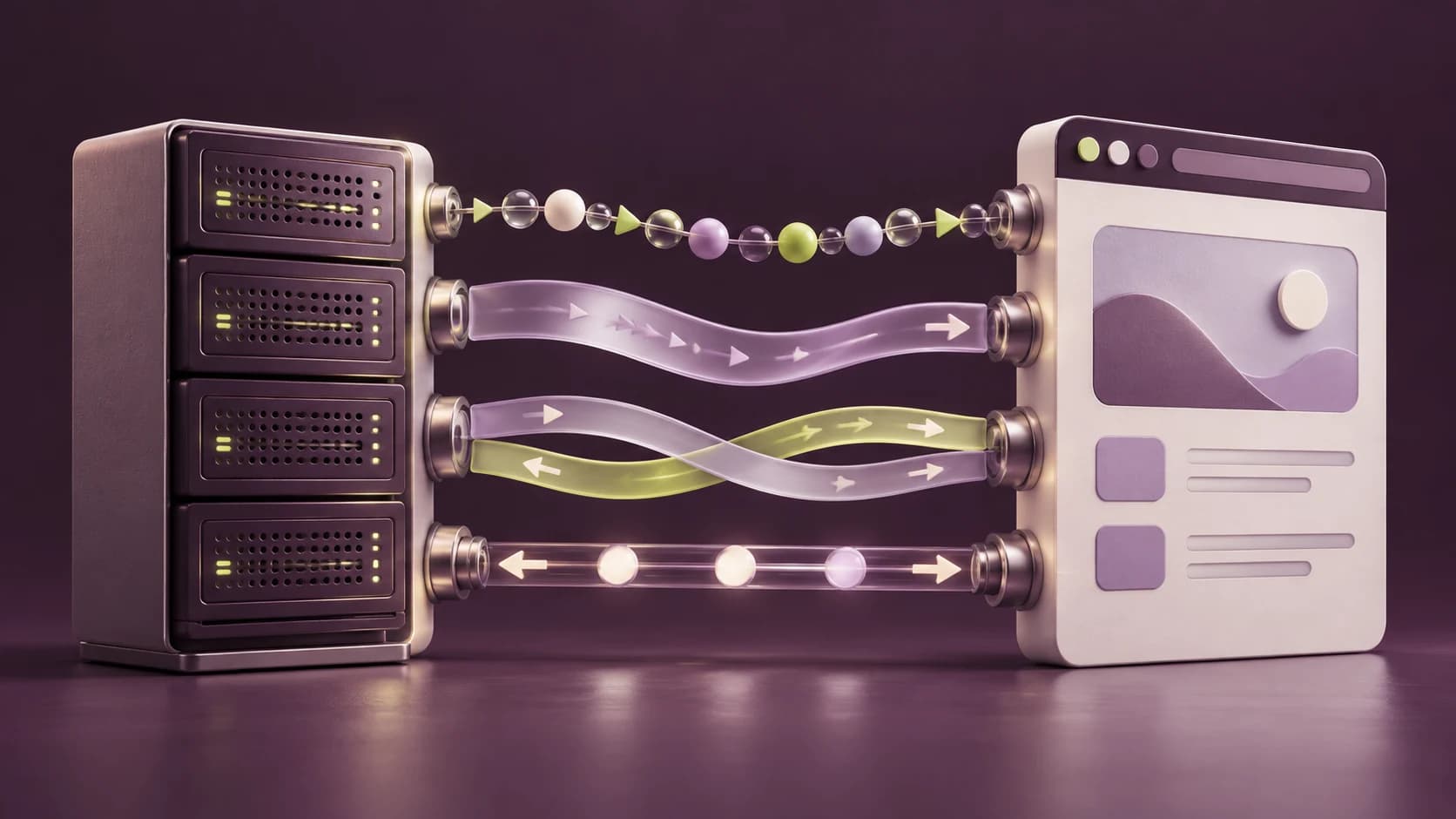
Real-Time Data Display Methods in Web Applications: A Detailed Architectural Comparison
An architectural deep-dive and benchmark of Long Polling, Server-Sent Events (SSE), WebSockets, and WebRTC for modern real-time web applications, complete with latency characteristics and scalability guidelines.
Real-Time Web Architecture in 2026
Modern users expect live, reactive interfaces: messaging notifications, live stock quotes, delivery tracking, and shared collaborative canvases. Choosing the right real-time protocol is one of the most critical decisions in system architecture.
Here is a comprehensive technical comparison of the four primary real-time communication protocols.
1. Long Polling (HTTP)
- How it works: Client makes standard HTTP requests; server holds the connection open until new data is available or a timeout occurs.
- Pros: Works through every legacy firewall, zero protocol upgrades required.
- Cons: Massive HTTP header overhead, high latency, poor scalability under thousands of concurrent users.
- Best For: Fallback mechanisms when modern protocols are blocked.
2. Server-Sent Events (SSE)
- How it works: Client establishes an unidirectional HTTP connection (
text/event-stream); server pushes text events continuously over the open connection. - Pros: Simple HTTP-based protocol, automatic reconnection, built-in browser support (
EventSource), HTTP/2 multiplexing. - Cons: Unidirectional (server-to-client only), text payloads only.
- Best For: LLM streaming responses (ChatGPT style), live notifications, stock ticker dashboards.
3. WebSockets
- How it works: Upgrades standard HTTP/1.1 connection into a persistent, bidirectional, full-duplex TCP socket.
- Pros: Sub-millisecond latency, minimal header overhead (2 to 10 bytes), bidirectional binary and text transport.
- Cons: Requires dedicated stateful socket servers or distributed pub/sub bridges (Redis, RabbitMQ).
- Best For: Multiplayer gaming, collaborative document editing, active trading platforms, instant messaging.
4. WebRTC
- How it works: Peer-to-peer UDP/TCP transport with direct media streaming and DataChannels.
- Pros: Lowest possible latency, peer-to-peer data transfer without central server bottlenecks.
- Cons: Complex signaling server setup (STUN/TURN/ICE), high setup latency.
- Best For: Video/audio conferencing, real-time telemetry, P2P file sharing.
Comparison Matrix
| Protocol | Direction | Overhead | Typical Latency | Browser API |
|---|---|---|---|---|
| Long Polling | Half-Duplex | High (Full Headers) | 500ms - 2s | fetch() |
| SSE | Server -> Client | Low | 50ms - 150ms | EventSource |
| WebSocket | Full-Duplex | Ultra-Low (2 bytes) | 5ms - 30ms | WebSocket |
| WebRTC | P2P Bidirectional | Ultra-Low | < 10ms | RTCDataChannel |